

In Malaysia, companies issue two main types of shares: Ordinary shares and Preference shares. But what sets them apart?
Dividend Rights:
Preference shareholders get priority for dividends over ordinary shareholders.
Ordinary shareholders receive dividends after preference shareholders.
Voting Rights:
Preference shareholders typically don’t have general voting rights but may vote on matters affecting their rights.
Ordinary shareholders have voting rights, usually one vote per share, influencing company decisions.
Voting rights allow shareholders to influence crucial decisions like choosing the board of directors and major moves such as mergers. More voting rights mean more influence on the company’s direction.
Dual-Class Shares (DCS) structure is common among publicly traded companies in the United States. It divides ordinary shares into Class A (for the public) and Class B (for founders), offering different voting rights.
Class A shares have limited voting rights, while Class B shares grant more voting power.
For example, Class A shares might offer one vote per share, while Class B shares might offer ten votes per share.
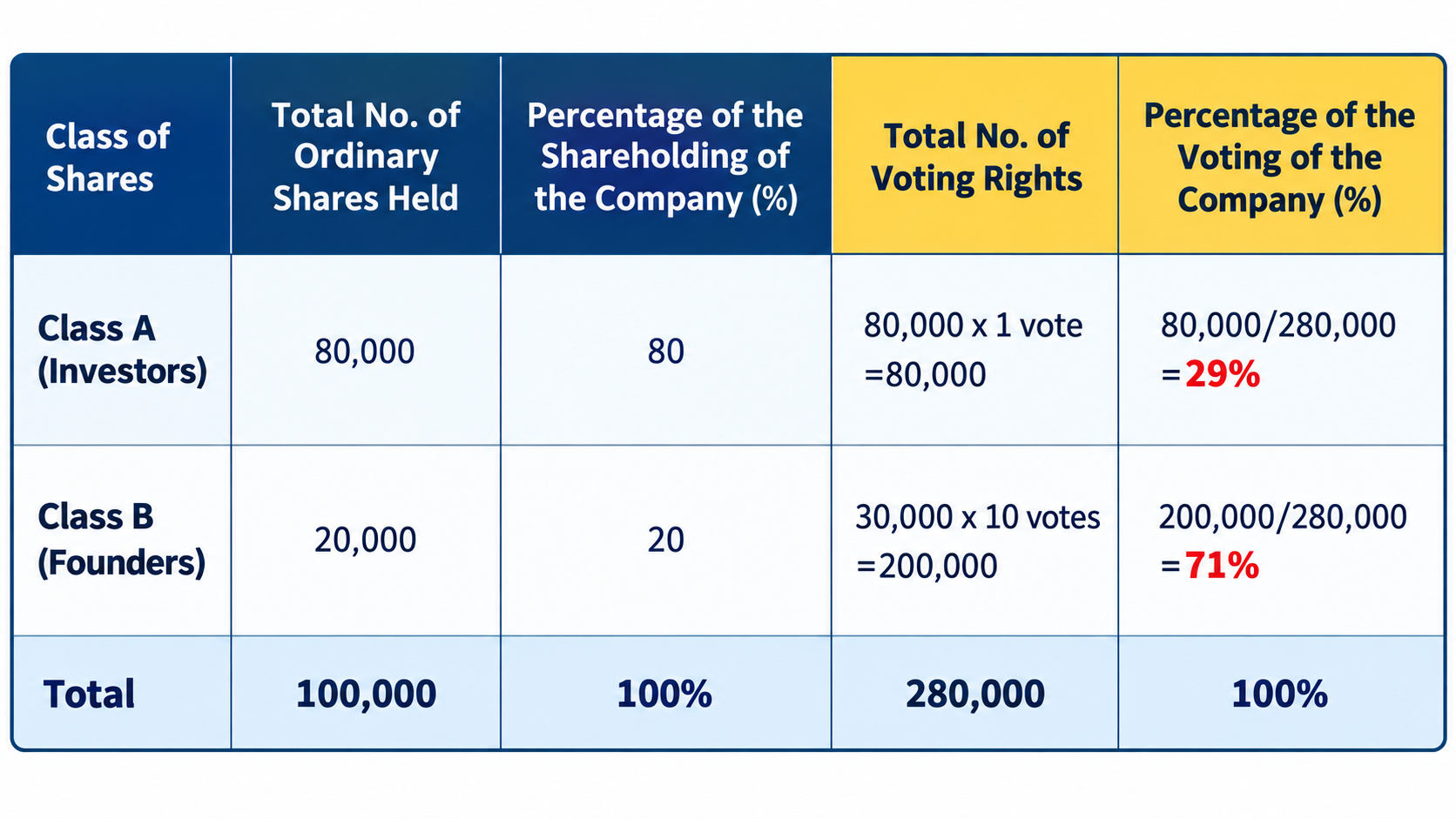
Yes, small and medium-sized enterprises (SMEs) in Malaysia can adopt DCS. While more common among larger corporations in the United States, SMEs can benefit too. Seeking professional advice is wise to align this approach with their objectives.
Yes. The Malaysian government announced plans to allow the listing of dual-class shares on Bursa Malaysia to encourage high-growth tech companies to list locally.
Grab Holdings Inc. is a notable example. Despite owning only 3.6% of ordinary shares, co-founder Anthony Tan maintains majority voting power, empowering strategic control while accessing public capital markets.
Dual-class shares offer a structure where certain shareholders, often founders, have more voting power, ensuring control over company decisions.
Disclaimer: This article is for general information purposes only and does not constitute legal advice. Specific advice should be sought based on the facts and structure of each transaction.